Associated at the midpoint of Nepal's Khumbu area, Mt. Ama Dablam is renowned as a remarkable peak in the Himalayas, standing at an altitude of 6,812 m (22,349 ft). The word "Ama Dablam," which consider as "Mother's Necklace," represents its unique form expressions, like a mother holding her child. This peak requires a mix of skill and strength to climb, offering magnificent views of nearby Himalayan mountains such as Everest, Lhotse, and Cho Oyu along the way. It's a challenging climb and special attractions draw climbers and adventurers worldwide.
On March 13, 1961, a historic first ascent of Ama Dablam was achieved via the Southwest Ridge by Barry Bishop (USA), along with Mike Gill and Wally Romanes (New Zealand), and Mike Ward (UK).
Some Noticable Records of Ama Dablam Expedition
The first ascent via the North Ridge was made in 1979 by Bill Denz from New Zealand.
Andy Cave and Brendan Murphy were the first British climbers to ascend the North Face in alpine style.
The first recorded winter ascent was in 1993 by two Japanese alpinists.
Climber Carlos Buhler from the USA made the first solo ascent in the 1990s.
Amadablam I was first summited by Maurice Herzog and Louis Lachenal via the Northwest Ridge in 1950, and it has since gained a reputation for its risky climbing conditions, including unstable glaciers and steep sides prone to avalanches. Despite its intimidating character, Amadablam draws climbers looking for the ultimate test of ability and endurance, enticed by the prospect of conquering one of the world's tallest peaks. The peak is also culturally significant, named after Amadablam, the Hindu goddess of fertility and agriculture. Its conservation area, which was created in 1986, spans a massive region of unspoiled natural beauty and provides a window into Nepal's rich cultural and biological legacy in addition to providing a challenging climbing experience.
Base Camp (4600m/15092ft)
Base Camp is the initial point of the most of the Expedition. Which located, at 4,600 m (15,092 ft.) above sea level, the base camp serves as the starting point for the ascent of Ama Dablam. This section provides climbers and support workforces with a planned starting location for acclimatization and preparations, acting as a courage hub. Before starting the ascent, climbers are physically and mentally strong along with the adaption of the altitude here and confirm their equipment and route preparations.
Camp One (5700m/18,800ft)
Following Base Camp, Camp One is the next stop for expeditions at 5,700 m (18,800 ft). The journey between base camp and camp one is not physically and mentally strenuous. There are no essentials of the fixed rope. This camping site plays the fundamental role during the journey, providing a brief break and a vital point for adjusting to the altitude. Camp One plays the most crucial role in providing the climber's awareness of the advanced challenged that expect in upcoming altitude.
Camp Two (5950m/19,521ft)
The climb goes on, with Camp Two at 5,950 meters (19,521 feet) ahead. This campsite is purposefully on the rough terrain of the mountain, serving as a base for climbers to gear up for the challenging sections and technical climbing to come. In this location, climbers encounter difficult sections and navigate challenging rock and ice formations while heading towards the top.
Camp Three (6200m/20,341ft)
Camp Three, fixed at the altitude of 6,200 m (20,341 ft.), which is the last and one of the most important high-altitude camp before the final push to the summit. Camp three section also provides a climber fixed rope. On a slender ridge, this camping site provides extensive panoramas of the Himalayan topography and acts as a key spot for climbers to relax and plan for the final push of their expedition.
Summit (6812m/22349ft)
As the expedition crew successfully reaches the summit of Ama Dablam, stand-up at 6,812 m (22,349 ft.) above from sea level. This significant attainment gives climbers magnificent views and a unique feeling of success when they successfully reach the top of the peak. The climbers' goal is to reach Ama Dablam's peak, overcoming its challenging climb to admire the stunning views of Everest and the surrounding mountains.
We operate our expedition in the Himalayas with well-trained Sherpas of western standard born and raised in the foothills of the Himalayas. Their excellence and glorious climbing history need no more explanation. Our Sherpas have climbed Everest and other peaks in the Himalayas of all height multiple times, and prove themselves to be the best climbers and Leader/guide.
Our Sherpas will make sure that cooperation with other Sherpas from different companies and Base Camp organizations is intact. It is essential that all climbing teams work together in the Himalayas with proper contribution from all operators on the tasks such as route fixing and ensuring safety of climbers from Base to the summit. Our Sherpas lead in these efforts.
How to Choosing an experience Provider
It is important for each climber to choose the right expedition guide service that not only suites their needs, but provides the best safely and secure mountaineering experience possible. There are more than 1,700 trekking companies in Nepal who offer 8,000 meter expeditions, but only about 30 companies who operate 8,000 meter peaks on a regular basis. We are proud to be one of these 30 companies and consistently offer, run and succeed at these types of expeditions year after year.
It is very important that the climbers who choose Satori Adventures for this trip of a lifetime experience have expectations that are compatible with the program we offer and the style of expedition Satori Adventures runs. We do not want to simply fill our expedition, but instead we want to comprise a team of companionable people who are focused on reaching the summit with the highest level of support and safety standards that can be provided by a guiding service. We team this with the best standards of food and quality equipment to further assist each client reach their full potential. We feel that we offer the best environment and opportunity for you to be successful on the world's highest mountain.
Diminutive climbing Team members
We are always developing and growing our operational systems to ensure you participate will provide as much as facilities provided. In the interests of giving you the most optimal chance to summit, we limit our team size to ensure the group summits on the best weather day. In big size of group offering cheap climbs often miss out as they split their groups over several potential summit days. We feel like our climbing members are feeling that they are climbing as a family and friends team even on international people. We accept maximum 08 people in a group and if we have more than that we always split in two groups. So that our base camp staff cooks, climbing Sherpa guide will fully take care about you and provide service as per your desire.
Maximum summit Success;
Satori Adventures methodology and tactical approach to climbing has achieve the highest success rates and our extensive experience gives us the edge when it comes to making the right decisions. We provide a consistently higher Sherpa and Guide ratio than any other operator, resulting in more support and backup for your summit attempt and therefore a greater safety margin and chance of success. There is always a 1:1 ratio of the climbing Sherpa/guide and client. We always use professional and experienced climbing Sherpa or guides who have all reached the summit of Everest.
Highly Qualified Sirdar/Team leader
Our guides are professionals who are trained and assessed either via the International Federation of Mountain Guides Associations (IFMGA) resulting in a greater repertoire of skills that enables them to provide a dedicated level of security to you during the expedition, or many years of mountaineering experience on the world's biggest peaks. Our guides are experience in both advanced and basic rescue courses and all have a minimum of 3 years guiding on Everest.
Advanced Communication method
Satori Adventures expeditions have been at the forefront of providing top communications for our expeditions. This allows us to obtain and deliver comprehensive weather forecasts via U.S., European and Kathmandu weather forecasting. Our lead guide is always equipped with a satellite phone during the climbing and at base camp. Two way radio communications between climbing members, guides, Sherpa and base camp staff is also provided. There is also local mobile network available at base camp that provides easy connection with your family during your stay at base camp.
Facilities camp setup at Base Camp and Kitchen
Satori Adventure focuses on comfortable conditions at base camp, including good quality food and other services. We find this helps clients with their overall success rate on the mountain. Our cooks are regarded as the best in the business, providing wholesome and appetizing meals with an agreeable array of menus to suit all your food requirements. The meals you are served on the mountain are also of the highest standard and designed to sustain you for the rigorous ascent. We offer various choices that will suit any diet plan, including vegetarian, continental, Indian and others. If you have special food consideration, please provide this to us 60 days prior to the expedition so we can plan the best meals for your trip.
Ultimately, the Ama Dablam expedition shows human capabilities of determination, skill, and grit when facing nature's powerful challenges. Throughout the entire expedition, there is essential of courage, strength, and collaboration. In the breathtaking Himalayas, climbers navigate challenging paths, overcome psychological and physical barriers, and forge lasting memories. More than just a mountain summit, Ama Dablam represents human effort and the intrepid spirit of exploration. The Ama Dablam expedition is more than just climbing; it's a journey of self-discovery, exploration, and deep environmental appreciation. Climbers not only conquer a mountain but also push their own boundaries and form a bond with the stunning Himalayan landscape. Ama Dablam invites adventurers to challenge themselves and discover the magic of the mountains—a journey that will inspire, humble, and transform all who start on.
First Ascent: 13 March 1961 by Mike Gill & Wally Romanes(NZ), Barry Bishop(USA) & Mike Ward(UK)
Meals: B/B plan in Kathmandu & B,L,D in during trekking and climbing period
Highest access: 6812m/ 22334ft
Duration: 33 Days
Group Size: 01-10 people per group
Co-ordinates: 27°51'42'' N, 86°51'40'' E
Location: Nepal/ Everest Region
Country: Nepal
Airport: Kathmandu
Grade: Mixed Alpine AD
Accommodation: B/B plan in Kathmandu & Pokhara and B, D, L during the trekking and Climbing
Transportation: Car, Jeep, Flight
Best season: spring: April-May and autumn: September-October
Major Activity: Trekking/ climbing
Culture: Sherpa, Tamang
Mode of Travel: Tea House/ Camping
Climbing route: Southwest and northeast
Himalayan sights: Everest, Lhotse, Pumori, Kongde


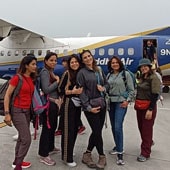
I have been bringing groups to Nepal primarily for trekking the high Himalayas and Satori is my business partner in Nepal. The service is just excellent..everything is spot on with Satori.
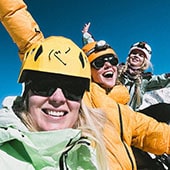
Satori Adventures is the best tour operator I have worked with in Nepal. Always great service and good prices. My first choice for my adventures in Nepal!
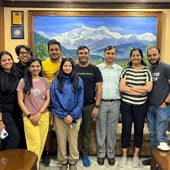
One of the most reputed and well managed agencies. The owner Mr Rishi is a true gentleman and knows the pulse of the mountains. His team his flexibility when it comes to management is truly exceptional.
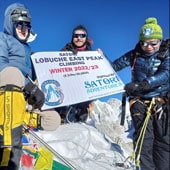
Satori Adventures is the best host for any activities in Nepal! We utilized their knowledge and experience in organizing high-altitude expedition for a part of our group. For another part of our team, they managed to provide an incredible hike to the base camp





 USA
USA MEXICO
 FRANCE
 CHINA
CHINA JAPAN
JAPAN